As a child, I wanted to be Billy Graham. I thought he had the coolest job in the world, traveling the globe and telling everyone about Jesus.
When I grew older, though, I learned that girls weren’t allowed to become evangelists. I decided I would do the next best thing and become a missionary, instead.
.
.
Nehemiah 3:12
I pictured myself roughing it in the jungles of the Amazon like Elisabeth Elliot, translating the Bible while eating bugs around a campfire. God had other ideas, though. When I finished college, I tried to become a missionary, but He shut that door. I didn’t know what else to do with my life. Finally, my mother gave me some sage advice: just pick a direction and go, honey. If the Lord needs you, He’ll know where to find you, just like with Moses and the burning bush. I decided that if I couldn’t talk about the Bible, I could at least travel the world. So I went to work for an airline and moved to Denver.
Where are they going today?
Every morning as I rode the employee bus across the tarmac, I would look at the planes towering above me. Where were they going? I would dream of climbing on board and flying somewhere overseas.
Spiritual But Not Religious
I stopped attending church while I lived in Denver. Why should I? “The harvest is plentiful, but the laborers are few …” (Luke 10:2 NASB). Well, I had been willing to go harvest souls, but God didn’t want me. Fine, then. I didn’t need Him, either. I never stopped believing in God or the Bible; I just lived my life without going to church.
During this time, the Lord led me to my future husband. We met through a Christian dating site. He sent me a nice email, and I . . . hit delete. After all, nice men don’t exist on dating sites, do they? I had certainly learned that the hard way. Fortunately, God prompted him to try again. And fortunately, he listened, or this would be a very different story. And so, reader, I married him. My husband lived in North Yorkshire, England. If that name sounds familiar, it’s probably because Yorkshire is famous for its literary associations.
“You might want to change your shoes…”2
You see, James Herriot lived in the village of Thirsk, just down the road from our city of York.
And of course, there’s the trio of sisters who wrote novels that are only known today by Thought Daughters (including me) . They lived in Haworth, a village on the wild Yorkshire moors.
I loved my new English home, but there was just one problem: I had to start attending church again. You see, my new husband was a Local Preacher3 in the Methodist Church, and so attending church was part of the deal in marrying him. I thought I wouldn’t mind, but I was wrong. I grew up in a gospel-singing, “Preach it, brother!” Baptist church. Now, though, I was exposed to the liturgical church for the first time. At first, I didn’t like it, simply because it was too different from what I had known.
Truth, Beauty, and Goodness
Over time, though, I grew to love it. I loved the feeling of being rooted in a church that stretched back to ancient times. I loved following the rhythm of the church year, which pulled me from the world’s emphasis on money. Gradually, I felt myself changing spiritually.
A mystical, historical church4
I love this quote because it’s pretty much how I grew up, too. In my church, we were supposed to be fighting a spiritual war against our culture. We believed that we were under siege, just like medieval people defending a castle. It was exhausting, and certainly didn’t help us love our enemies. It also didn’t attract many people. Who wants to live in a bare castle where everyone is constantly on the defensive?
It wasn’t until I moved to Britain that I began learning a different way of being a Christian. Instead of attacking us, I came to realize that most people were ignoring us. They were going about their lives out in the village. I realized that I wanted to lower the drawbridge and leave the castle. Instead of fighting the culture, what if I simply went out into the village and showed them the love of Christ?
One Sunday we were visiting my mother-in-law. Since her village had no Methodist church, we went to the Anglican church for morning service. During the sermon, I did what I have done since I was a child: flipped through the hymnal. Suddenly, I saw a page with the title, Hymn For Female Saint’s Days. I felt a physical pain go through me, as if somebody hit me.
Who were all of these female saints? Why did the Anglicans know about them and not me? I was so mad that I nearly jumped up and yelled at the vicar. Then deep down, I felt another pain. Maybe I didn’t know about these female saints because I wasn’t supposed to know about them. Maybe this wasn’t some sort of accidental omission by those who ran my church, but a deliberate strategy to keep me from knowing about my spiritual past.
In order to do so, I knew I would have to attend a seminary like my father. He was a minister, and I loved hanging out in his study at church. His shelves were full of books. Looking at those books filled me with awe. So many big thoughts about God! How could people have so many ideas about God? How could you write entire books about the Bible? I dreamed of attending seminary like my father when I grew up. I wanted to read all of those books!
Long lost sisters . . .
Looking back, I can see that my “road in the woods”5 moment occurred in that Anglican church in England. You see, at that moment, I had a choice. I could have just dismissed my anger. I could have just forgotten about it and returned to the spiritual ignorance I had endured for my entire life. Or I could do something with the information I had just learned.
I chose the latter path. I decided that I would try to track down my missing spiritual sisters. However, I didn’t know how to go about it. Eventually, I found some books about historical Christian women, but then life got in the way. Due to financial hardship, we had to move back to America. And so I packed my books away.
“Who are outstandingamong the apostles” (Rom 16:7)
After we settled in America, I remembered my childhood dream. Surely if I enrolled in seminary I could find out about my spiritual forebears! And yet, each time I thought about it, the devil would bombard me with doubts and fears. You’re not smart enough. You’ll never be able to handle writing those advanced-level papers. You’re too old. I listened to that voice of negativity for years.
“The toughest job you’ll ever love”6
Finally, I couldn’t resist the Lord’s voice any longer. I still felt scared to death, but I enrolled in a seminary, anyway. As soon as I did, I received an email about a new class they were introducing. It was all about women in ancient Christianity! Talk about a divine confirmation.
I wish I could say that everything magically got easier once I started at seminary. It didn’t, though. I was plagued by doubts the entire time. Each time I handed in a final paper, I just knew the professor would laugh at my amateur efforts. Each time I received it back with an “A” grade, I felt like Sally Field at the Oscars. “They like me! They’ll let me stay!”
So here I am. I’m old, maybe even old enough to wear a purple scarf with my red hat.7 That means I’ve got a lot of time to make up. I’ve got plenty to say about the Bible and not much time left to do it in. I’m just going to start talking and let God decide whether I should be doing so. To get things started, here’s a quote from one of my spiritual sisters that I learned about in seminary:
Maybe a speaking woman is like an ass–but I can tell you one thing, the ass seen the angel when Balaam didn’t.
Jarena Lee8
SUBSCRIBE TO OUR NEWSLETTER
Photo Captions. Note: unless otherwise attributed, all photos were taken by me.
Repairing a house while on a mission trip to the Navajo Reservation. Pink hats and power tools. Awesome!
The prayer chapel at College Church of the Nazarene in Olathe, KS.
4. Downtown Denver at night. Flickr user: Larry Johnson https://www.flickr.com/people/drljohnson Next to it is a picture of the 16th Street pedestrian mall. Courtesy of Matt Wright at English Wikipedia.
5. Promotional image from PBS. My husband’s sister and her family have a farm in Yorkshire. This means that, like James and Siegfried, I have worn a pair of “wellies” (rubber boots) in a farmer’s barn. Sadly, though, I have not worn ovrealls like Rachel since high school. (Is anyone else old enough to remember wearing overalls with only one strap fastened?)
6. Copy of well, Jane Eyre. Thank you to my public library for loaning me this copy. I thought about using a normal copy, but then I discovered this one and thought it was way cooler.
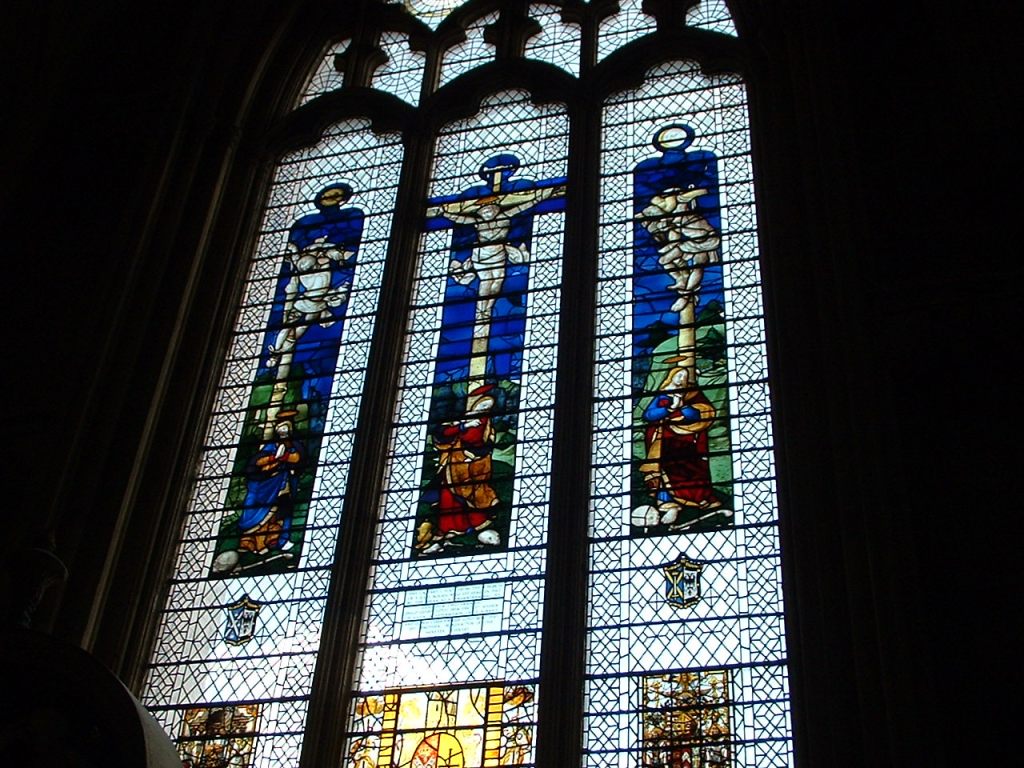
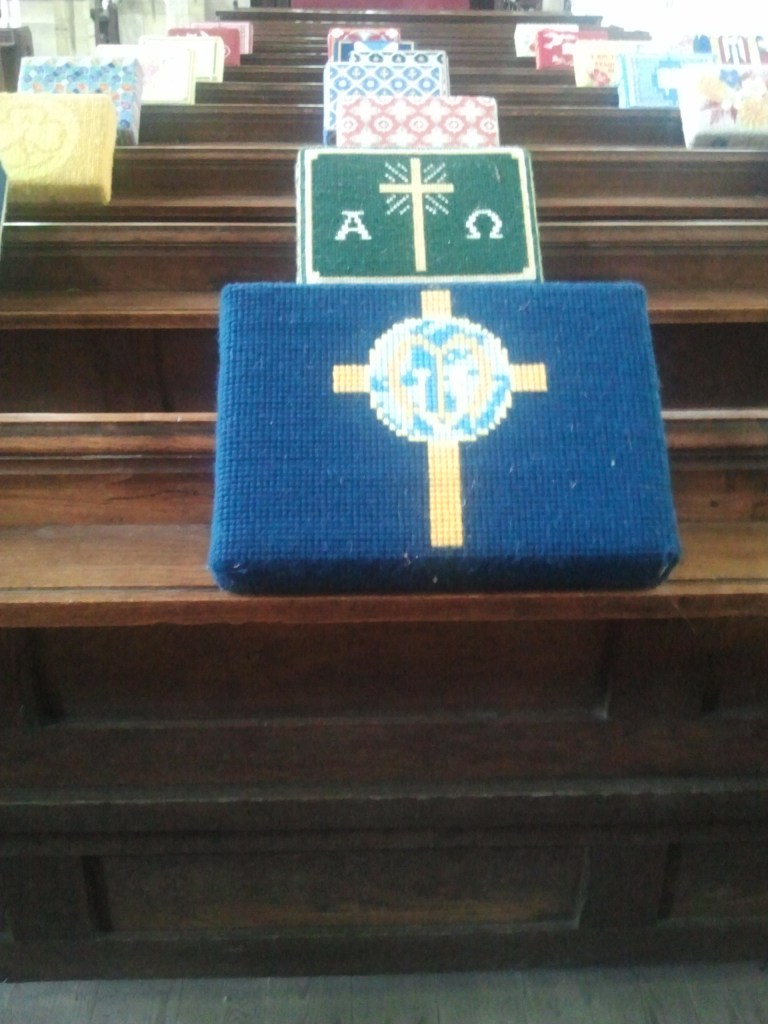
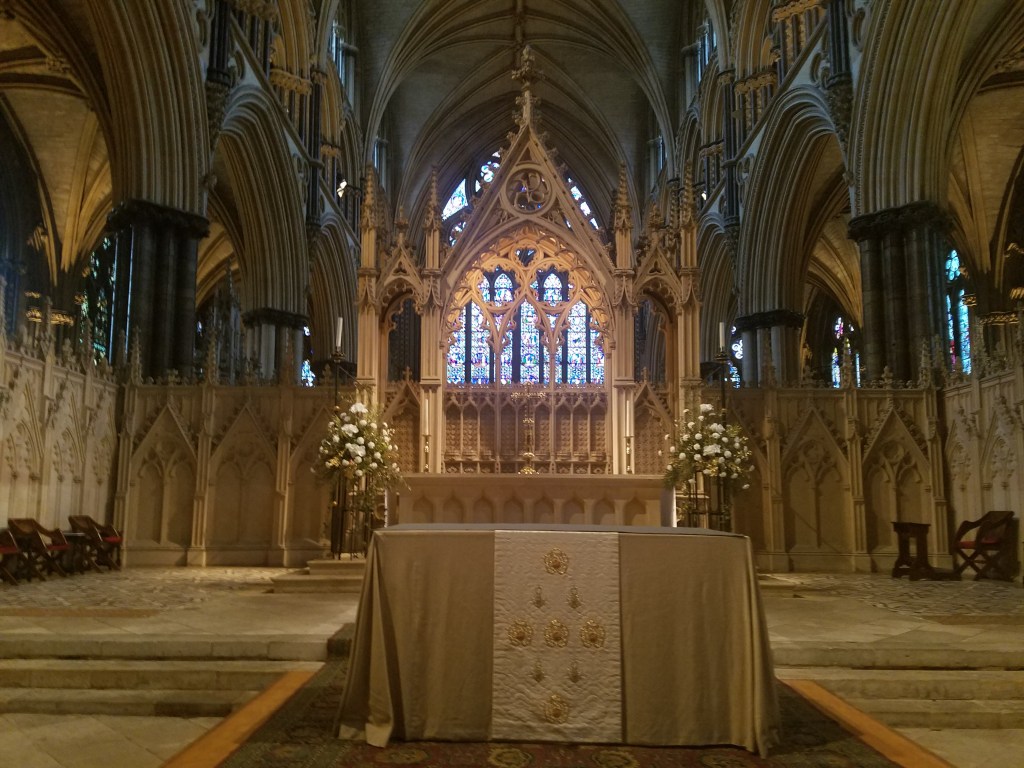
7. The Crucifixion Window in York Minster Cathedral. Beneath it, from left to right: a kneeling cushion in St. Jame’s Anglican Church in Louth; the Central Tower in York Minster; the High Altar in Lincoln Cathedral.
8. Caernarvon Castle in North Wales. Remember the evil king from Braveheart, Edward I? The Welsh hated him, too. One good reason why is this huge fortress that Edward built when he conquered Wales. The guide at Caernarvon told us that when it was originally built, the native Welsh people were strictly forbidden on pain of death from entering. Somewhere there is a spiritual lesson in that statement.
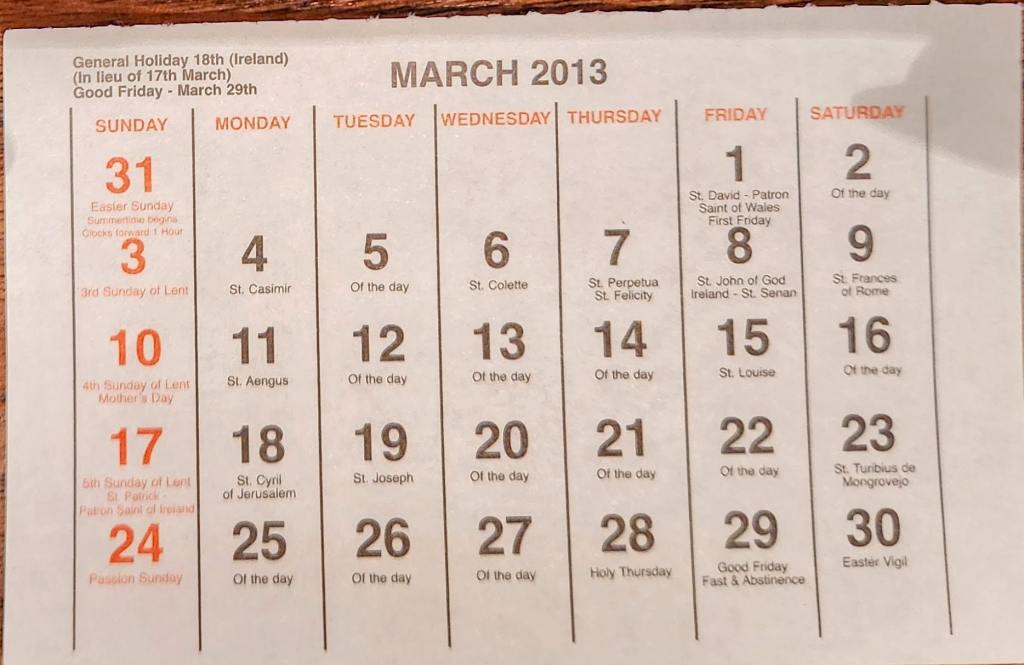
9. Page from an Anglican calendar of saints. This was given to me by one of my husband’s relatives and remains one of my treasured possessions. Note the female saints that are listed on it.
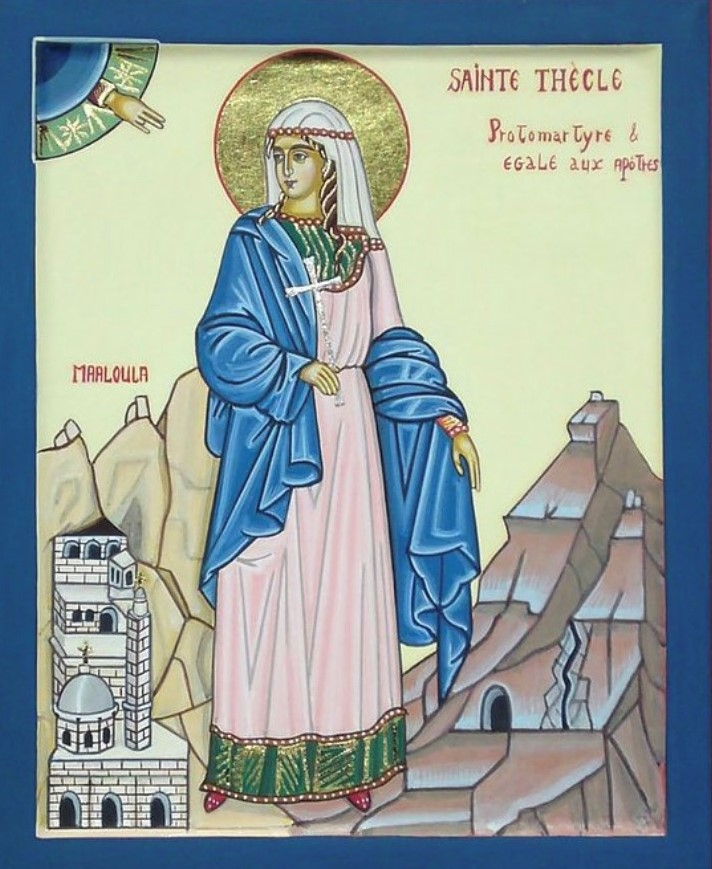
10. Icon of Andronicus and Junia, who are mentioned by Paul as being fellow apostles (see below). Beneath it, from left to right: Icons of two women who were famous in ancient Christianity, Thekla and Macrina. (Courtesy of Axia Women and Wind Ministries.) The story of how Thekla followed the apostle Paul, and her near-martyrdom, became a “bestseller” among ancient Christians. St. Macrina was the sister of Sts. Gregory of Nyssen and Basil the Great. Gregory wrote that Macrina immersed herself in the Scriptures from childhood, and rebuked Basil for his arrogance and love of worldly learning. You know that Gregory was probably laughing when he wrote that.
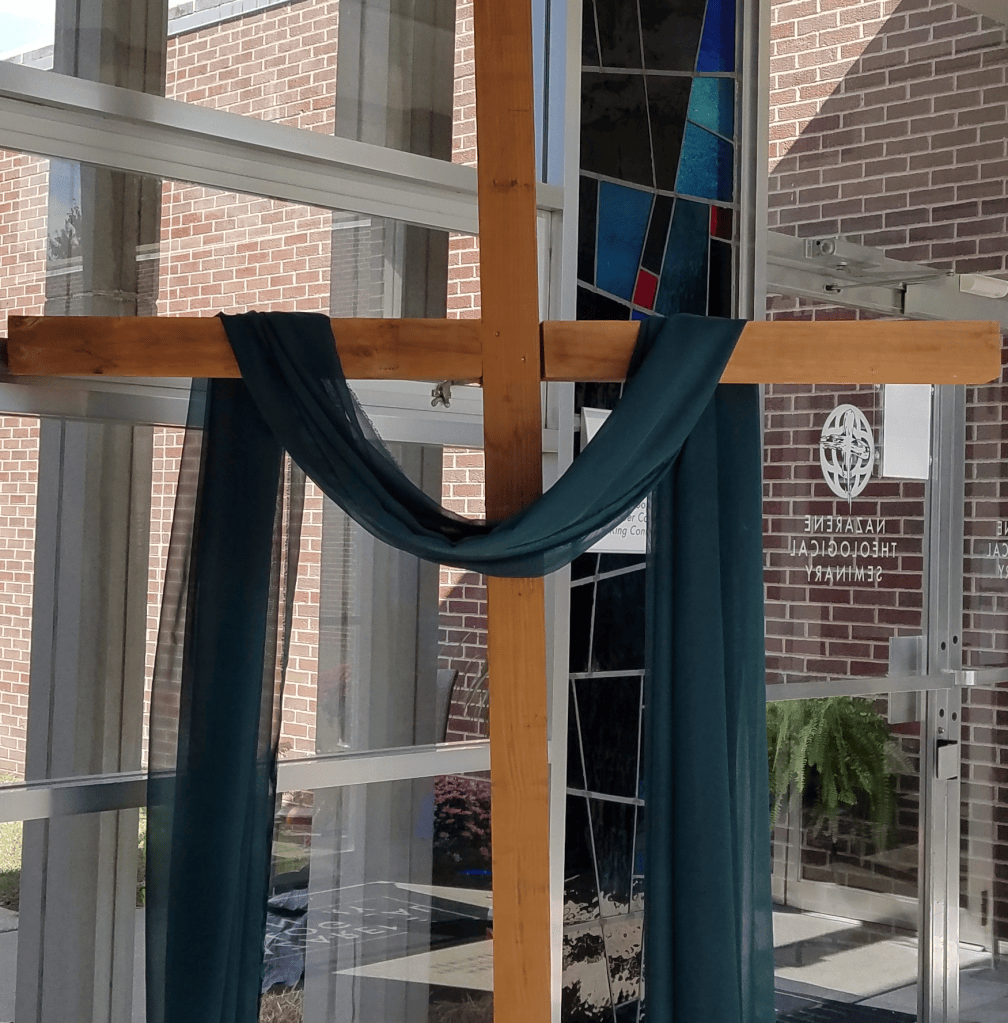
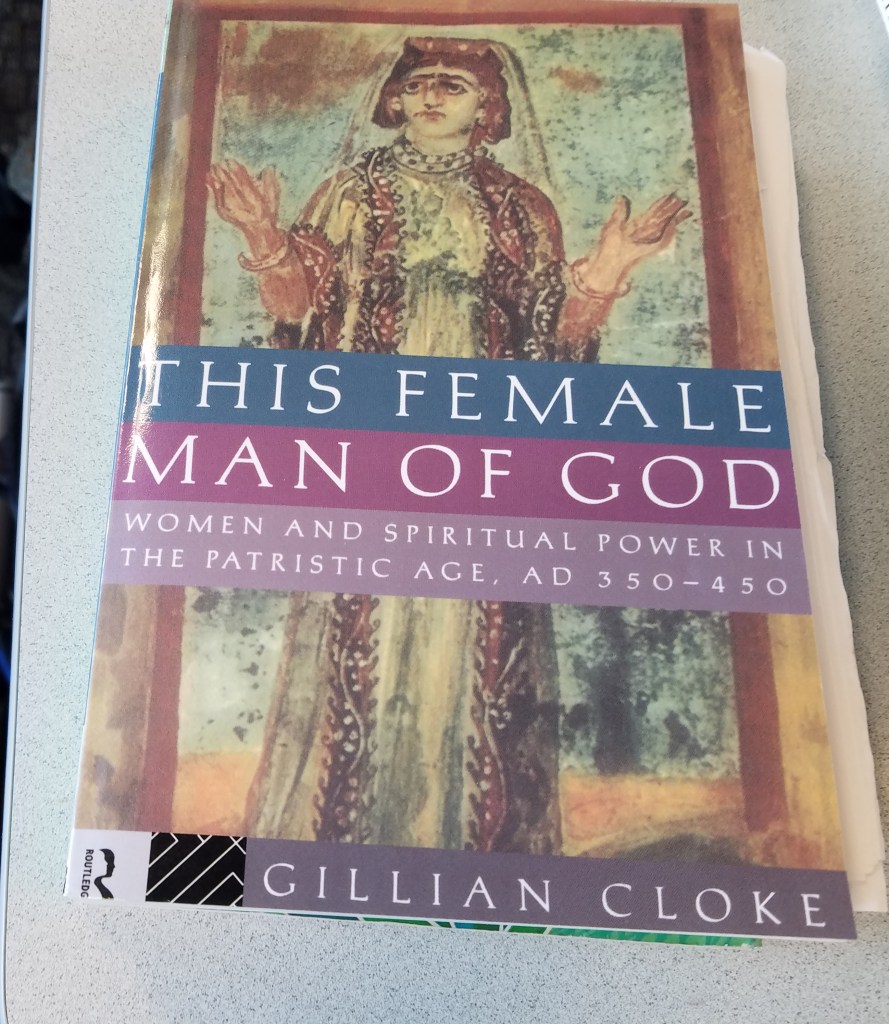
11. The cross in the walkway connecting the library and common room at my seminary. The teal cloth indicates that the it is Ordinary Time. The picture was actually taken in October. Beneath it, from left to right: A book reccommended by my professor. Inside the door to my seminary’s library. (My idea of heaven would be to die and be buried here.) The complete writing of John Wesley, from the collection of rare books in my seminary’s library.
12. My red hat, encircled by my purple scarf. You’ve been warned.
Footnotes:
Nehemiah 3:12 states that “Shallum . . . made repairs, he and his daughters” (NASB). They were helping to repair the broken walls of Jerusalem after they returned from exile. You go, girls!
Siegfried to James when he unexpectedly takes James to visit a farmer. Like any country vet, Siegfried always carried with him a good pair of “wellies” (rubber boots). My husband’s famiy has a farm. Like Siegfried (and eventually James) I had the pleasure of donning wellies while I mucked around in their the barn. Sadly, the last time I rocked a pair of overalls like Rachel was when I was a senior in high school. Is anyone else old enough to remember walking around with only strap fastened on your overalls? We thought we were so cool, when the entire school was dressed the same way. ↩︎
Local Preachers are specially trained men and women who can conduct services in the absence of a minister. Because of a shortage of ordained ministers in Britain, LP’s conduct most Methodist services. A lectionary is a read-through-the-Bible plan, only it’s stretched over three years instead of just a single year. In liturgical churches, it’s traditional for the minister or priest to preach on the reading for that Sunday.
Although this wonderful church formed me . . . I still felt like we were missing something. Our faith, as a stalwart outpost of the kingdom in a threatening world, seemed somehow precarious. …There was no sense at all of the whole mystical, historical massiveness of a church that had been around for two thousand years.Chris R. Armstrong, Medieval Wisdom for Modern Christians: Finding Authentic Faith in a Forgotten Age↩︎
Two roads diverged in a wood, and I— I took the one less traveled by, And that has made all the difference. Robert Frost, “The Road Not Taken” ↩︎
Old advertisement for the Peace Corp.
“Greet Andronicus and Junia, my kinsmen and my fellow prisoners, who are outstanding among the apostles, who also were in Christ before me” (Romans 16:7 NASB). For centuries, the Church accepted Junia as a female apostle. In modern times, however, some biblical scholars have tried to say that she was actually a man, or that she was only “well known to the apostles”. Both views have been thoroughly debunked.
When I am an old woman I shall wear purple With a red hat which doesn’t go, and doesn’t suit me. And I shall spend my pension on brandy and summer gloves And satin sandals, and say we’ve no money for butter. I shall sit down on the pavement when I’m tired And gobble up samples in shops and press alarm bells And run my stick along the public railings And make up for the sobriety of my youth. Jenny Joseph, “Warning”
Religious Experience and Journal of Mrs. Jarena Lee, Giving an Account of Her Call to Preach the Gospel, published in 1849.